

V0467 PEG - Another slightly crazy star - Delta Scuti
Initially listed by several stellar databases as an EW star, a W UMa type contact binary with few observations, this piqued our interest and prompted us to investigate further. However, upon examining our light curves, something seemed amiss. Stars of this type are typically very rounded; in fact, this is one of the defining characteristics of EW contact binaries. Yet, over several nights of observation, two patterns stood out: sharp peaks and variations in the shape of an "M." Doubt quickly arose, enough to warrant more in-depth investigation. We therefore present here the results of our photometric and spectroscopic observations, as well as our analysis of this star's status.
Introduction
The initial photometries yielded a B–V index ≈ 0.45, consistent with an F2 star (~6500 K). Other, more scattered measurements subsequently appeared, suggesting that the star was intrinsically variable and exhibiting irregular profiles.
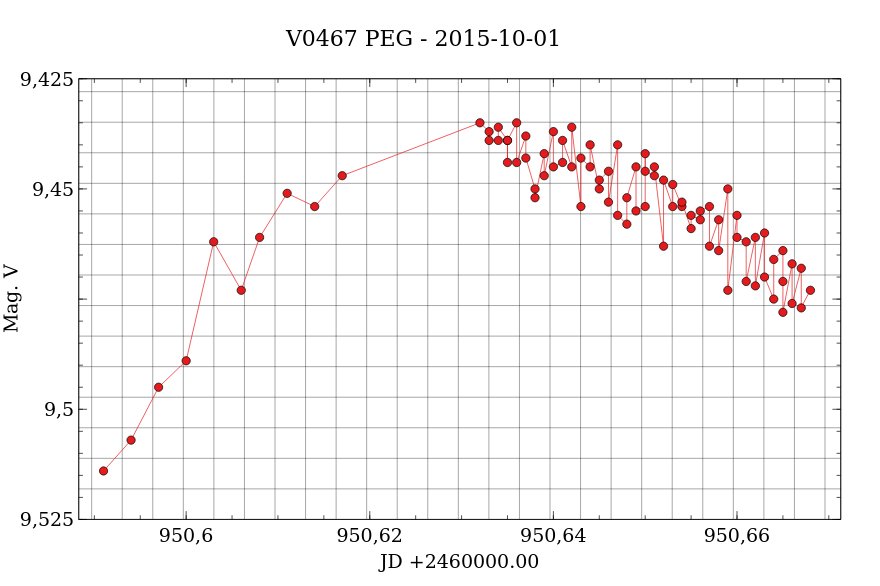
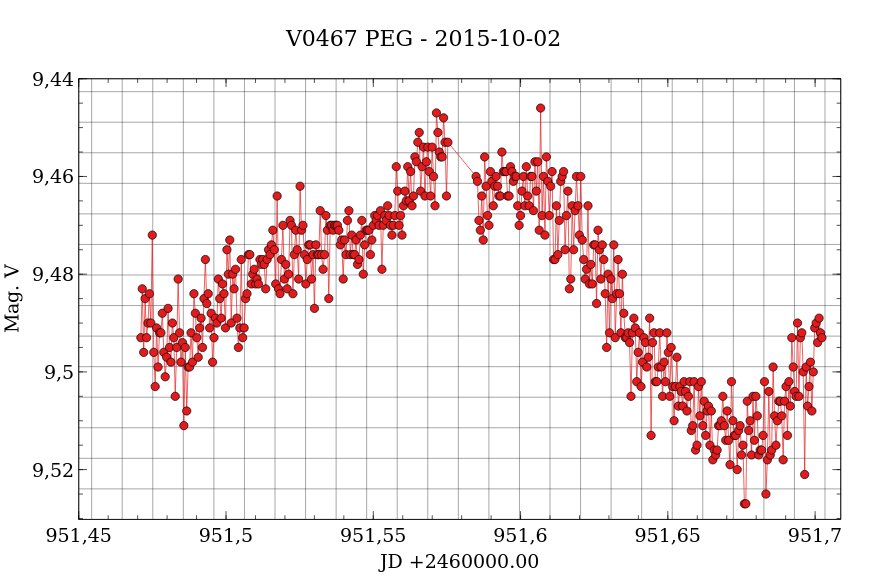
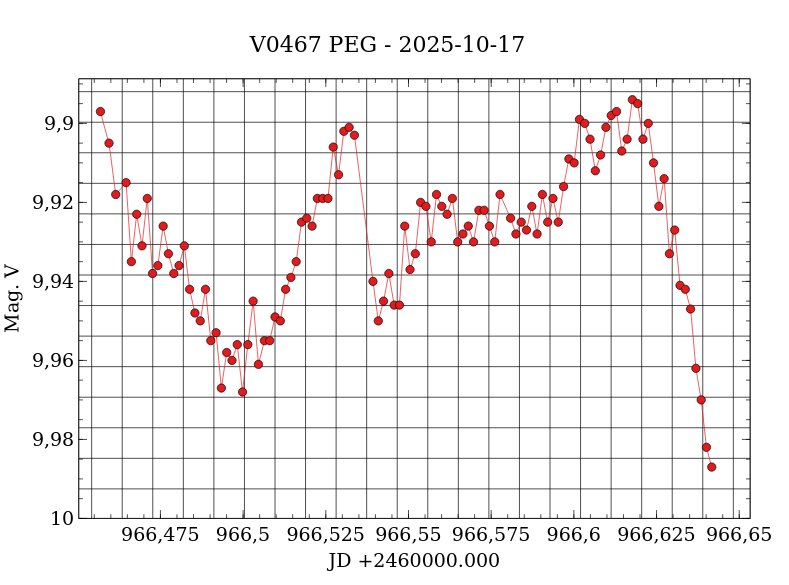
Faced with these light curves, we must immediately rule out the hypothesis of a contact binary: the curves are too sharp and more closely resemble those of fast pulsating stars. The fast period, according to our observations, is 0.1564079 days (3.75379 hours). Its luminosity oscillates between a maximum of 9.430 V, a minimum of 9.520 V, and a secondary minimum around 9.510 V, for a star of approximately 1.5–1.6 M☉.
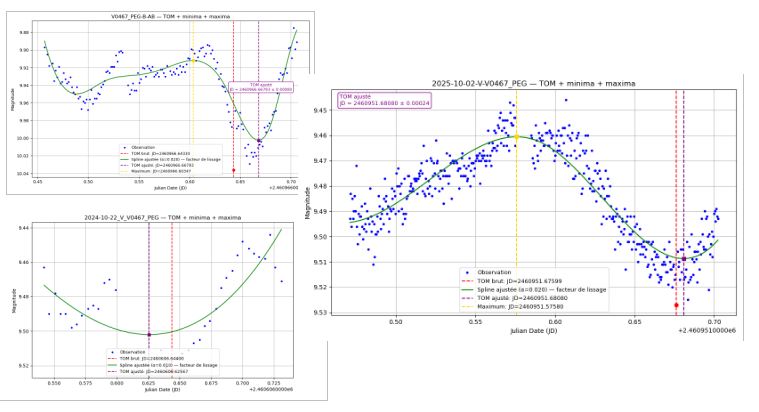
Results of a few nights of observation with the script for TOM (Time Of Minimum) analysis
Closer monitoring and reference searches then began, ultimately leading to the discovery in the AAVSO VSX that the Chandra satellite had observed the star in 2015. Its inclusion in the X-ray data, combined with cross-referencing with optical catalogs, led to its reclassification as Delta Scuti. The weak X-ray excess detected in 2015 is typical of an A/F star at the end of the main sequence, reinforcing the hypothesis of a pulsating star.
The κ mechanism, or "Eddington valve," causes the star's upper layers to swell and contract, then return to normal.
This status confirms our observations. Their kappa mechanisms, also called "Eddington valves," cause their upper layers to swell and contract, then return to normal, generally in a linear fashion.
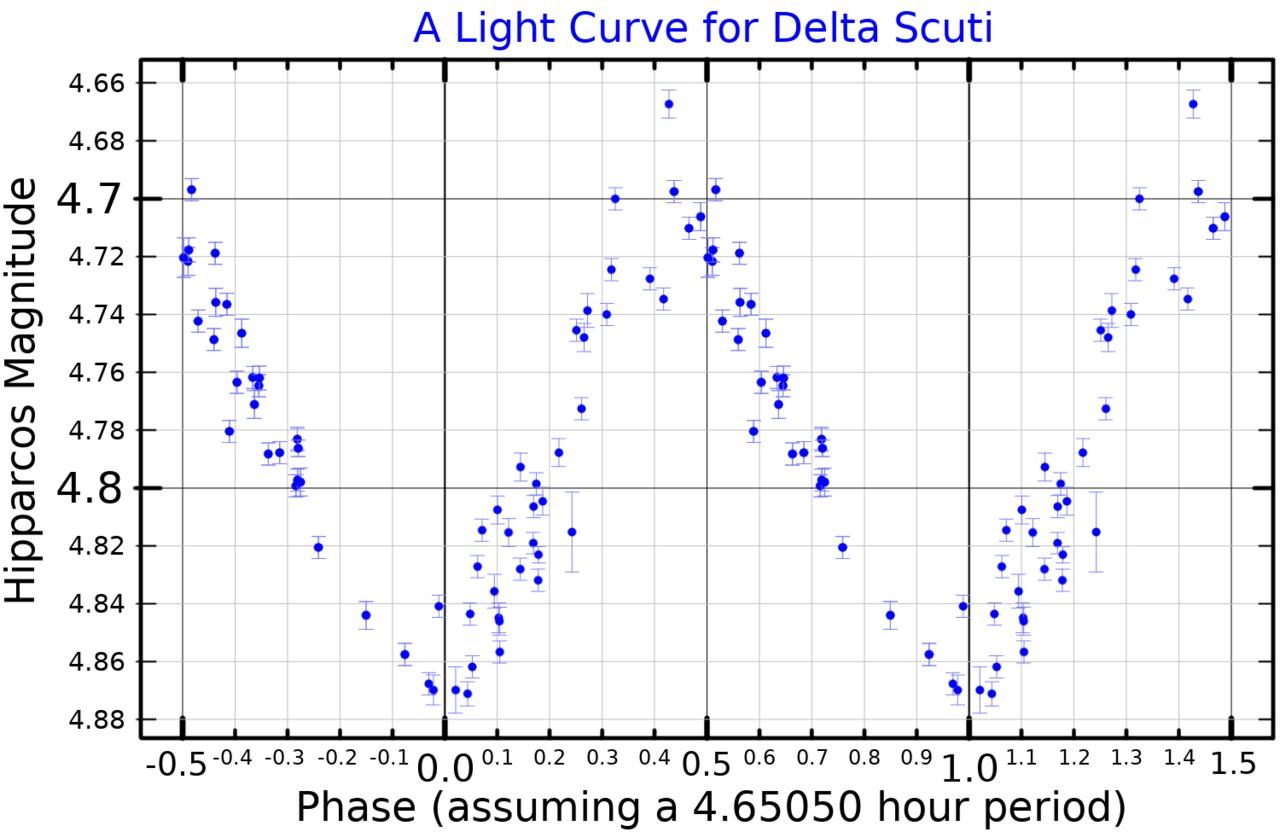
However, their behavior is often much more complex than a simple linear or regular variation. So, the classic Cepheids inflate and deflate regularly. The Delta Scuti often exhibit non-radial pulsations and several harmonics, which is observed in V0467 Peg.
 |
|
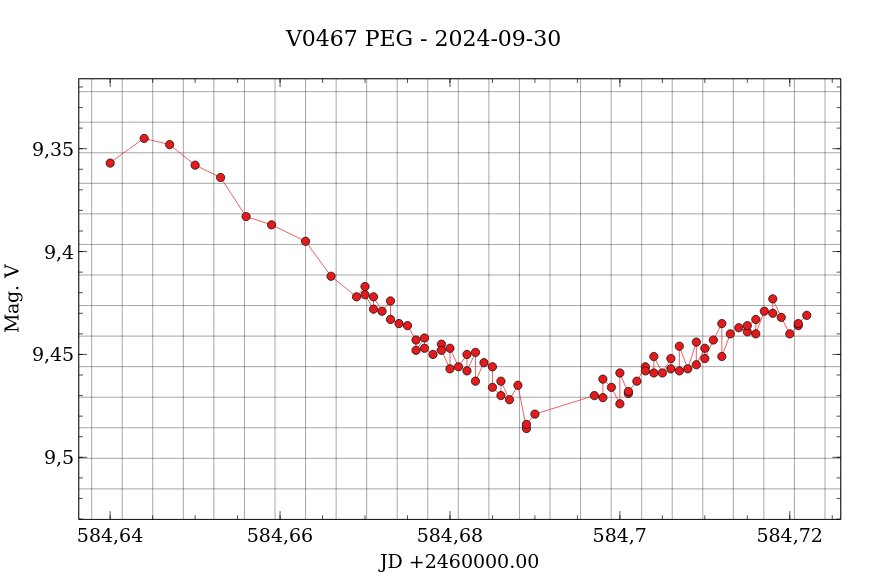
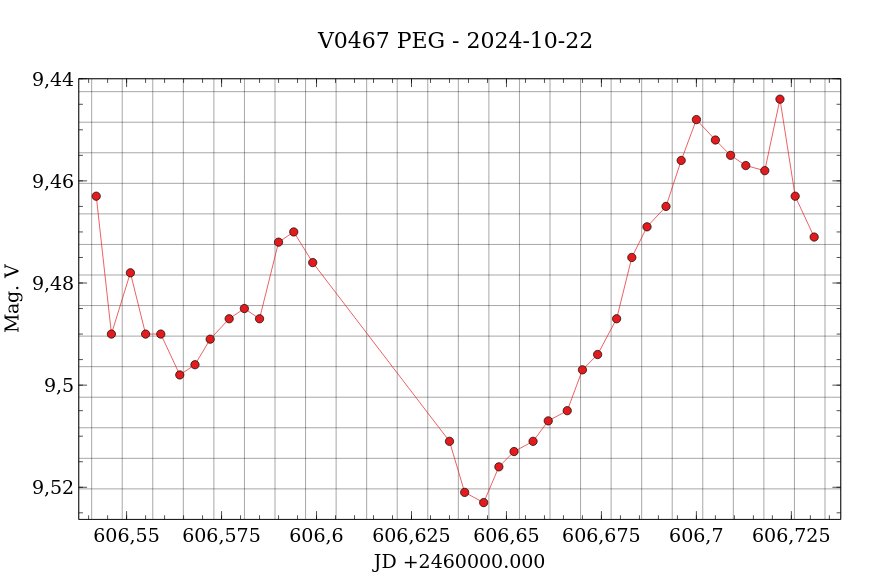
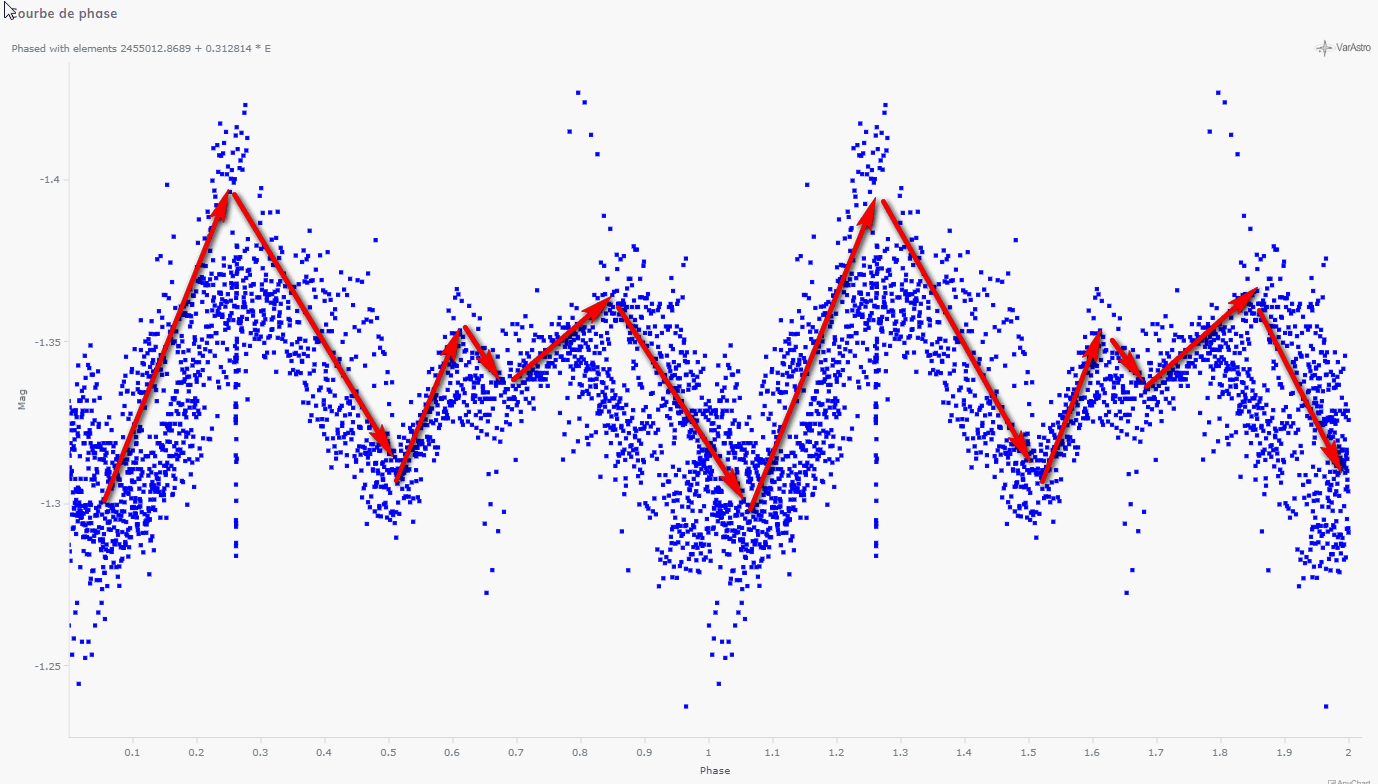
Examining certain light curves, two nights in particular show a two-peak structure within the same cycle: a sharp initial peak, typical of δ Scuti stars, followed by a slight dip and then a rebound that climbs almost as high. This profile is naturally explained by the presence of a strong first harmonic, which distorts the light curve and gives the illusion of a "double peak" within the same cycle, rather than by a secondary eclipse as in a contact binary. Other curves do not show this structure as clearly, which underscores the irregular and multiperiodic nature of V0467 Peg, a common signature of δ Scuti stars.
 |
 |
 |
 |
 |
Summary chart of observations - courtesy of VarAstro.cz |
Spectroscopic observation:
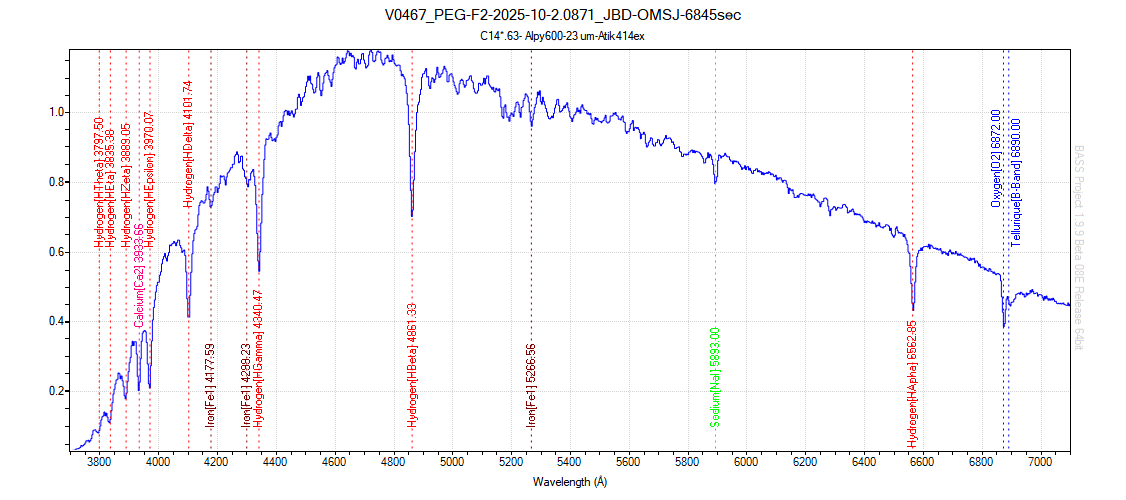
The relatively stable spectroscopy also confirms the star's nature: compact, still on the main sequence or just about to leave it, but already pulsating like a Delta Scuti. It is therefore at the very beginning of its δ Scuti phase, at the precise moment when the crossing of the instability band begins.
The absence of emission lines, broadened profiles, or stellar wind signatures indicates a calm, unexpanded atmosphere, typical of a star that has not yet begun its subgiant expansion. This spectrum thus confirms that V0467 Peg is in a transition phase, still compact but already unstable, precisely at the moment when δ Scuti pulsations become observable.
Stellar evolution
The progenitor stars of Delta Scuti are generally A2 to F5 type stars that have burned their hydrogen on the main sequence for several billion years.
Their lifespan depends strongly on their mass:
|
spectral type |
Mass (M☉) |
Duration on the main sequence |
|
A2 |
2.2–2.5 |
~0.7 à 1.0 billion years |
| A5 |
1.9–2.1 |
~1.0 à 1.2 billion years |
| F0 |
1.6–1.8 |
~1.5 à 2.0 billion years |
| F5 |
1.3–1.5 |
~2.5 à 3.5 billion years |
When the internal equilibrium is disrupted by the gradual depletion of hydrogen, helium begins to dominate in the core. During this transition, the star expands slightly and its internal structure becomes unstable. This is when the κ mechanism, also known as the Eddington valve, is activated.
|
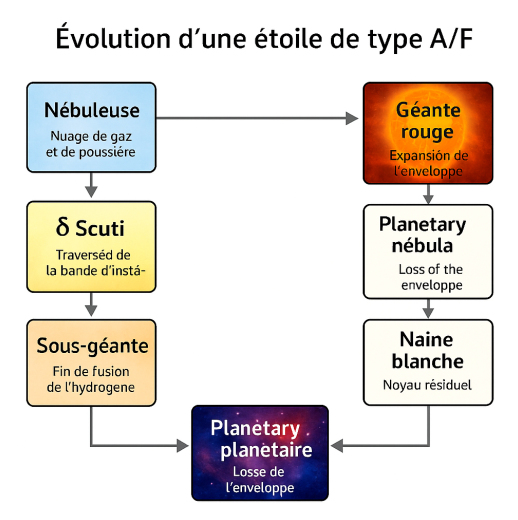
The principle is simple: When a star contracts, it heats up, the pressure increases, this pressure causes the outer layers to expand, as they expand, they cool, this cooling reduces the pressure, the star contracts again… And the cycle begins anew. This process produces the rapid pulsations characteristic of Delta Scuti. In the case of V0467 Peg, classified as F2, this means that it has spent approximately 2 billion years on the main sequence and is now crossing the instability band. This δ Scuti phase is very brief on the scale of its life: only 3 to 8 million years, or 0.1% to 1% of its total existence. After this short period of pulsations, the star will become a subgiant, then a red giant. It will not end as a supernova: once it has exhausted its fuel, it will simply shed its outer layers, much like M27, leaving behind its incandescent core—a white dwarf. The consistency between photometry (rapid pulsations, visible harmonics) and spectroscopy (stable atmosphere, F2 profile) reinforces the interpretation of a star at the end of its main sequence, operating within the Delta Scuti instability band. |
 |
Conclusion
All photometric and spectroscopic observations confirm that V0467 Peg is an F2-type star located at the end of the main sequence and within the Delta Scuti instability band. Its short period, moderate amplitudes, and the presence of harmonics in some light curves are consistent with a multiperiodic pulsator. The stable spectrum, lacking signatures of atmospheric expansion, indicates a still-compact star, in agreement with its evolutionary state.
V0467 Peg thus represents a typical example of an intermediate-mass star (~1.5–1.6 M☉) at the beginning of its δ Scuti phase. This δ Scuti phase is very brief: only a few million years. More broadly, the transition between the end of the main sequence and entry into the red giant branch represents about 5 to 15% of its total life, or 100 to 300 million years. Its future evolution will lead it towards the red giant branch, then towards the formation of a planetary nebula and a white dwarf, a bit like Messier 27 and what will become our sun.
References :
These subsequent studies show that δ Scuti can exhibit nonlinear, multiperiodic behaviors, and fine structures in the curve:
-
Ziaali et al. (2019) — global properties of δ Scuti
-
Poro et al. (2024) —period-luminosity relationship
-
Guo et al. (2025) — δ Scuti TESS
-
Wikipedia (simplified summary)
Pour expliquer la physique interne :
-
Eddington (1926) — Eddington valve
-
Cox (1980) — pulsation theory
-
Aerts et al. (2010) — modern asteroseismology
Pour le period‑doubling :
-
Buchler & Kolláth (2011) — non-linear theory
-
Moskalik & Buchler (1990) — bifurcations in the pulses
-
Études Kepler/TESS (Ziaali, Guo) — δ Scuti complexes
JBD-2026